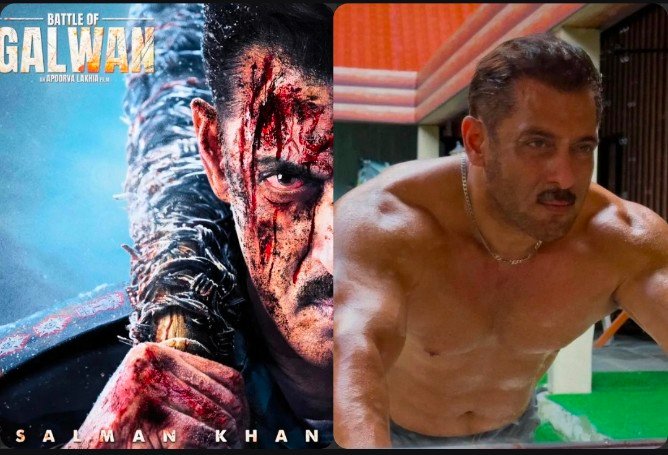
Salman Khan’s much-anticipated film Battle of Galwan has landed into controversy even before it’s release. The film is inspired by the brutal June 15, 2020 clashes between Indian and Chinese troops in the Galwan Valley of eastern Ladakh has drawn sharp criticism from Chinese media and commentators, who claim it misrepresents the historical events and exaggerates the narrative for dramatic effect.
The teaser was launched on December 27, 2025, shows Salman Khan portraying Colonel Bikkumalla Santosh Babu, believed in Indian media reports to be one of the key figures in the 2020 Galwan skirmish. Visuals feature intense battle sequences including hand-to-hand combat scenes that have drawn attention and online debate.
Chinese state-run newspaper Global Times and other outlets responded by accusing the film of presenting a distorted and one-sided narrative of the Galwan Valley clash. Critics argued that the portrayal does not align with their version of the incident and amounts to an “over-the-top drama” rather than an accurate recounting of historical events.
According to Chinese critics, Bollywood films are “entertainment-driven” and may massage emotional elements for cinematic impact, but no amount of exaggeration can change real history or influence a nation’s contested territory. A Chinese military expert was quoted as saying that “no matter how ‘over-the-top’ a drama may be, a nation’s sacred territory will never be affected by a film.”
Chinese social media users also joined the conversation. Some compared battle sequences in the teaser to scenes from Game of Thrones, while others joked that when “history falls short, Bollywood steps in.” Critics pointed to perceived inconsistencies in costumes, troop portrayals and environmental conditions shown in the trailer.
The Galwan Valley confrontation in June 2020 resulted in intense hand-to-hand fighting between Indian and Chinese forces the first deadly clash along the disputed Line of Actual Control (LAC) in decades. India officially confirmed the deaths of 20 soldiers, while China later acknowledged four casualties after initially denying losses.
Chinese media has repeatedly maintained that the Galwan Valley lies on its side of the LAC and placed responsibility for the conflict on Indian troops, accusing them of crossing into what China considers its territory. The Global Times article reiterated that portrayal a claim New Delhi firmly rejects and which forms the backdrop of the upcoming film’s narrative.
Indian filmmakers and industry figures have dismissed the Chinese criticism as predictable given the subject matter. They argue that cinematic freedom allows artists to depict national events from their perspective and that international reactions will not hinder the film’s release or commercial performance. In India, many viewers have praised the teaser for its patriotic tone, while others have debated its cinematic choices, such as costume design and the realism of battle portrayals. Some social media users have even compared parts of the teaser to iconic war sequences from popular global media franchises.