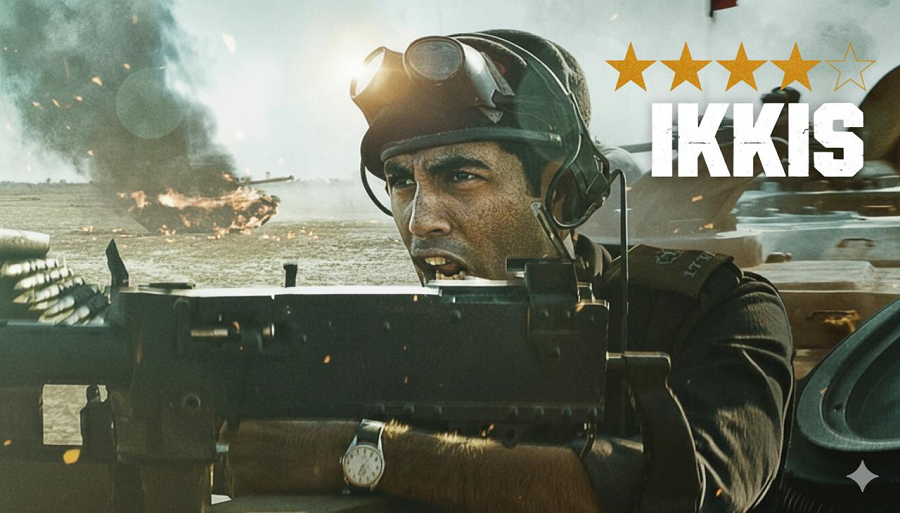
Ikkis Movie Review: 4 ratings
Director: Sriram Raghavan
When cannon balls from two tanks – one manufactured in Pakistan and the other in India — blow up, they take with them an iota of the defense budgets of both countries. When cannon fire and machine gun rounds are launched to shred through bodies that once carried dreams of reuniting with their wives, children, and parents, then the viewer is forced to think of war not as a necessity, but as a disease. Here, the chest does not swell. Slogans wield the weight of the meanings they correspond to. And the definition of nationalism is rewritten — from destroying an opponent with hate, to understanding an opponent and yet destroying him only because one is compelled to.
Arun Khetarpal, a disciplined soldier portrayed by Agastya Nanda – who does a fine job balancing innocence with fierceness – dreams of receiving a Param Vir Chakra, the highest military award for bravery. The film opens on Arun’s twenty-first birthday, interrupted by the breaking news of war and the orders for him to join his battalion. A parallel narrative, set thirty years later, follows Dharmendra, who plays Arun’s father. He travels for a college reunion and is hosted by Brigadier Naser, played by Jaideep Ahlawat.
The film keeps cross-cutting between these two timelines. In the first, Arun reaches the war zone and meets fellow soldiers — including Vivan Shah, the captain of his troop, and Colonel Hanut Singh, played by Rahul Dev—who orders Arun to remain behind the frontlines. In the second, Brigadier Naser escorts Dharmendra to his college, watches him reconnect with old friends (including Pakistanis), and insists on driving him to his ancestral home in Sargodha — the home he had to leave during Partition.
Throughout this journey, Naser grapples with a secret he wishes to reveal, despite his family urging him not to. The narrative is propelled by Arun’s passion for his country. He accomplishes every task set before him, ultimately becoming one of the youngest tank commanders. The film also touches upon Arun’s relationship with Kiran, played by Simar Bhatia whom he sneaks out to meet, leading to his first punishment in his otherwise disciplined academic journey. He later breaks off the relationship to stay focused, but never truly removes her from his mind.
Meanwhile, Dharmendra’s visit to his childhood home is filled with immense joy and nostalgia, enough that the current owner asks him to stay over. The next day, Naser takes him to the battlefield where Arun fought alone – destroying several tanks even after his own tank had caught fire.
The film is primarily about Arun’s valiant efforts, which gave India a major advantage in the Battle of Basantar. Yet, inherently, it explores the horrors of war and questions the decision-makers who send young men into battlefields. One scene stands out: Dharmendra describes the trauma of Partition through a telescope he had hidden inside a tree as a child, which he finds still there decades later. He asks, “How would it understand that it is no longer in the same country it was hidden in?” Deepak Dobriyal’s cameo as a wounded soldier scarred irreversibly by war and filled with hatred toward Indians verbalizes the anti-war theme of the film.
Dharmendra’s performance embodies vulnerability and conviction; his passing has created a void in the memories of the golden age of Indian cinema. The film, however, is not perfect. The writing of Arun’s relationships with his father and with his girlfriend is weak. His relationship with his mother is almost absent. The deaths of soldiers around Arun barely leave a lingering emotional impact. The film is built largely of major events; it seldom attempts to peer into Arun’s psychology. At moments, it even seems as though Arun is romanticizing death or greatness.
The character played by Jaideep Ahlawat feels almost too idealistic — one might assume he was fictional had he not been based on a real person. Such is the time we are living in, where our neighbour is first viewed as an enemy rather than as a human being. That is why this film is important. It does what it should do: it forces you to think. In a time defined by hate and by the capitalisation of hate Ragavan asks us to understand. Is it so difficult? I overheard a group of people discussing the film while I was descending the escalator. One man said the timing of the film’s release is completely wrong. Another objected to the counterpoint the film presents and the cinematic space given to a Pakistani character. He concluded that the film was “proPakistani.” I ask again: is it so difficult to understand?